|
FIRST UP THIS MONTH:
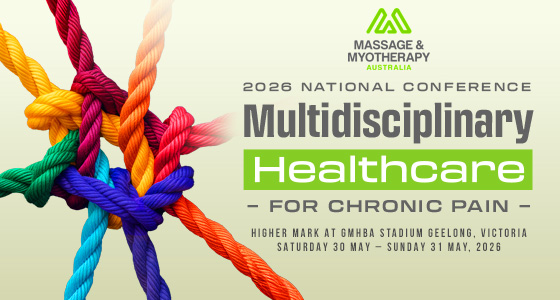
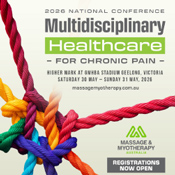
2026 National Conference Registration
The 2026 National Conference takes place 30–31 May at Higher Mark, GMHBA Stadium in Geelong, Victoria, this two-day event brings together leading presenters including Dr Felicity Braithwaite, Dr Sarah Fogarty, Aubrey Gowing, Stuart Hinds, Kelly Linaker, and Grant McKechnie. Sessions explore contemporary pain science, interdisciplinary perspectives and practical approaches you can apply directly in practice. With optional Pre-Conference Workshops also available, the Conference offers a concentrated learning experience that can influence how you practise long after the weekend ends.
Register by 11.59pm AEDT tonight 2 February 2026 to take advantage of our Early Bird Deal.
For full program details and to register, please click here.
SIRA update: no indexation to massage therapy fees in 2026
SIRA has advised that the Workers Compensation (Massage Therapy Fees) Order will not be indexed in 2026. This decision follows SIRA’s annual review, which found that NSW massage therapy fees remain significantly higher than comparable rates in other jurisdictions. As part of the review, SIRA compared current fees across states and determined that NSW rates are approximately 18–35% higher than those in Victoria and South Australia, with massage therapy not supported under Queensland workers compensation arrangements. Based on this analysis, SIRA has decided not to apply indexation for the 2026 period.
SIRA has confirmed that it will undertake another review as part of its annual indexation process in 2026 and will reconsider whether indexation will apply for 2027.
Current fees orders and Fees and Practice Requirements documents will be available on the SIRA website from 1 February 2027.
For more information, visit the SIRA website here.
Payday Superannuation: what small businesses need to know
From 1 July 2026, employers will be required to pay Superannuation Guarantee (SG) contributions at the same time as salary and wages are paid, rather than quarterly. This change, known as Payday Superannuation, will apply to all employers, including small businesses. Under the new system, super contributions must reach an employee’s fund within seven business days of each payday, with limited deferrals only available for new employees. Employers will also need to report wages and super liabilities through Single Touch Payroll each pay cycle. Late or missed payments may result in penalties and charges. Small businesses are encouraged to start preparing early by reviewing payroll systems, considering cash flow impacts, and ensuring staff responsible for payroll understand the upcoming changes.
You can read the Small Business PEAK Payday Superannuation Fact Sheet here.
For full details and official guidance, visit the ATO website here.
Develop an emergency management plan
The Australian Government’s ‘Emergency Management Plan Template’ guides you through creating a plan tailored to your clinic. It covers three essential parts and can be found at business.gov.au:
- Continuity plan: identify critical products, services and customers; capture key insurance details; outline backup strategies and staff training.
- Emergency action plan: list contacts for police, fire and ambulance; describe evacuation procedures; record where your emergency kit is stored; and assign clear roles so everyone knows what to do.
- Recovery plan: after a crisis, assess the damage, document insurance claims, list recovery contacts, and plan how you’ll reopen and communicate with clients.
The guide also reminds business owners to keep copies of critical documents (evacuation maps, insurance policies, etc) and to rehearse and update your plan regularly, Even if you’ve never faced an emergency, having a plan gives you confidence that you can protect staff, patients and your livelihood.
Download and learn more about the emergency management and recovery plan template and prepare your practice by clicking here.
|
– ADVERTISEMENT –
 |
Cyber security awareness in 2026: building safer small businesses
As small businesses continue to rely on digital systems, cyber security awareness is becoming an essential part of professional practice. Online bookings, electronic client records, digital payments and cloud-based software all support efficiency, but they also introduce risks if cyber safety is not actively managed. The Cyber Wardens Program is a free, government-backed initiative designed specifically for small businesses. It provides practical, self-paced online training to help business owners and staff understand common cyber threats, strengthen everyday digital habits and respond appropriately if a cyber incident occurs. The training is accessible, jargon-free and focused on real-world small business scenarios.
In 2026, cyber security is less about technical expertise and more about awareness, consistency and good systems. Building cyber knowledge within your business helps protect sensitive information, maintain client trust and supports long-term business continuity.
Learn more about the Cyber Wardens Program and access the free training here, eligible for CPE Points/Hours.

SMS and email marketing: prepare for the July rules
From 1 July 2026, any business sending branded marketing messages via SMS or MMS must register its sender ID on the SMS Sender ID Register. This change aims to reduce scam messages that impersonate trusted businesses. A sender ID is the name displayed at the top of your text message (for example, ‘ATO’ or ‘myGov’). If you don’t register your ID, telcos will mark your messages as “Unverified,” grouping them with unsolicited and scam messages.
It’s important to remember that electronic marketing is regulated by the Spam Act 2003 and Telecommunications Act 1997. Before sending an email, SMS or instant message you must:
- Get clear permission from the customer, either express or inferred
- Provide an easy way to unsubscribe and honour requests within five working days
- Include your business name and contact details in each message.
For more details and to register your sender ID, see the business.gov.au guide on promoting your business by email or text messages by clicking here.
|
– ADVERTISEMENT –
 |
| |
Pain Revolution's National Pain Collective Event
Pain Revolution is hosting an online webinar open to all health professionals, featuring Professor Tamar Pincus, Dean of the Faculty for Environment and Life Sciences at the University of Southampton, and Professor Lorimer Moseley AO, Distinguished Professor and Founder and CEO of Pain Revolution. The session, How ‘soft’ skills create a bang and an echo, will explore how communication, language and other so-called ‘soft’ skills can meaningfully influence pain outcomes and clinical practice. All funds raised from this event will directly support Pain Revolution’s Local Pain Educator Program, helping to improve pain education and care in communities across Australia.
Registrations are now open via Eventbrite here.
To learn more about Pain Revolution and its programs click here.
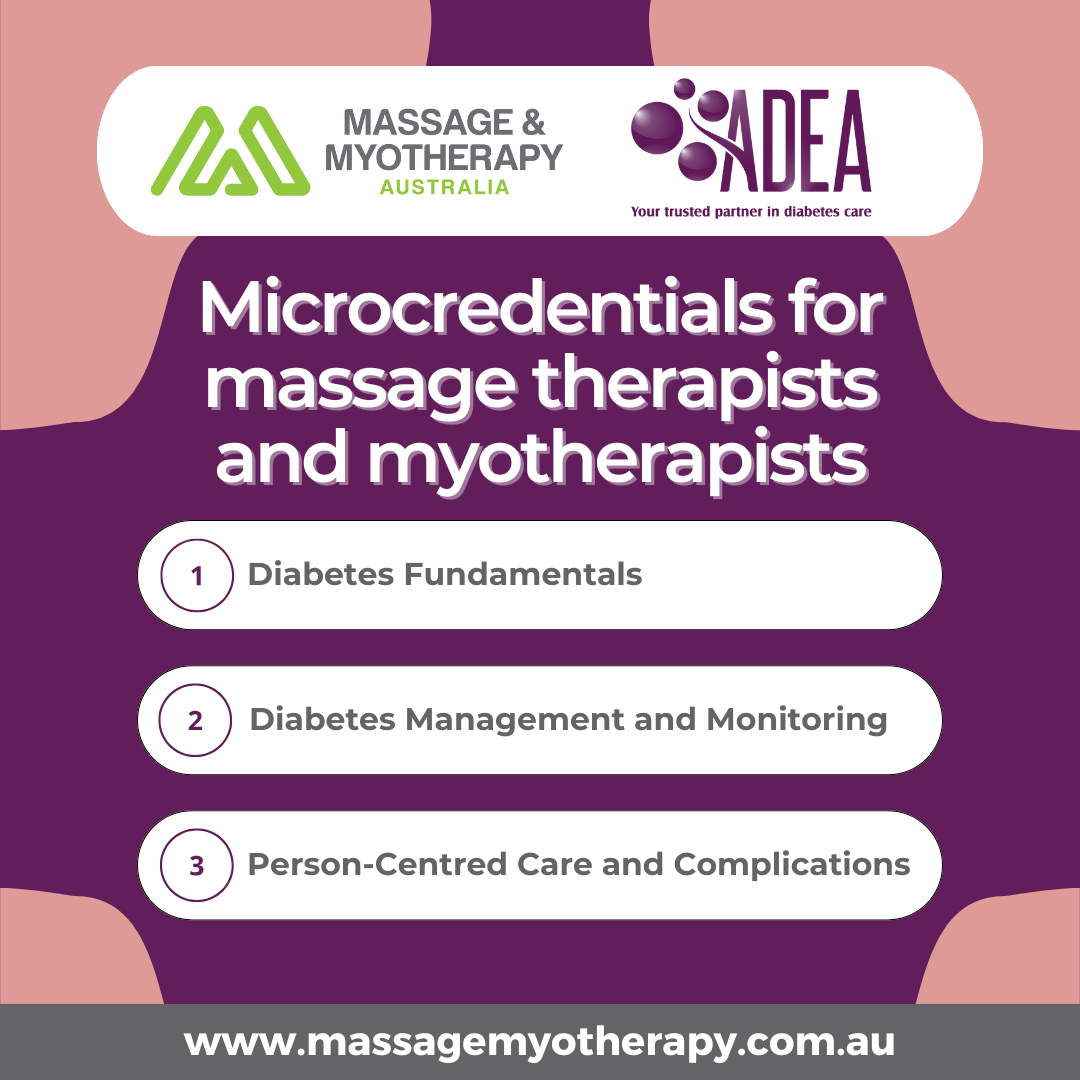
Have you checked out these Diabetes microcredentials for members?
Massage & Myotherapy Australia has partnered with the Australian Diabetes Educators Association (ADEA), and created a suite of online microcredentials designed specifically for qualified massage therapists, remedial massage therapists and myotherapists. These are the only microcredentials of their kind in Australia made for our profession and Association members. If you’re seeing more patients with diabetes (or at risk of it), these modules are a practical way to build confidence and strengthen your understanding of how diabetes can impact the body, healing, and long-term health. Members are eligible to claim 10 CPE Points and 1 CPE Hour per microcredential completed. Please provide the Association with a certificate to claim CPE Points as they will not be automatically added. Click below to learn more and enrol:
You can hear more about this partnership in Episode 92 of Connect, available on Facebook, YouTube and the Association website.
Timing of sports massage may influence sprint performance
A study published in the International Journal of Therapeutic Massage & Bodywork investigated whether the timing of sports massage affects 60-metre sprint performance in competitive athletes. The results showed that a brief sports massage delivered after warm-up led to faster sprint times, with greater improvements seen when an activation essential oil was used. The authors suggest post-warm-up sports massage may be a useful complementary approach for enhancing short-distance sprint performance.
To read the full study, please click here.
| MENTAL HEALTH & WELLBEING |
Support for members affected by recent natural disasters
Massage & Myotherapy Australia is, of course, aware of the fires and floods impacting communities across much of Australia and extends its support and sincere sympathies to all members affected during this difficult time. If you are experiencing challenges meeting membership requirements, including renewal fees or compliance obligations, as a direct result of these events, we encourage you to contact the Association. Support may be available, and each situation will be considered on a case-by-case basis.
Government assistance may also be available for individuals and businesses impacted by natural disasters, subject to eligibility and application processes. Further information is available via the following services:
The Association thanks members for your ongoing support and encourages anyone affected to stay in touch during this time. For more information click here
|
– ADVERTISEMENT –
 |
|